

As of July 21, 2026, available evidence does not confirm a nationwide styrene shortage in Russia. It does, however, show enough production, refining and logistics uncertainty to explain why industrial buyers are reassessing their supply options.
Yishun Chemical has recently received increased styrene inquiries from Russian buyers. This is a commercial observation rather than market-wide statistical proof, but it is consistent with a market in which procurement teams are placing greater value on alternative suppliers, documentation readiness and realistic delivery planning.
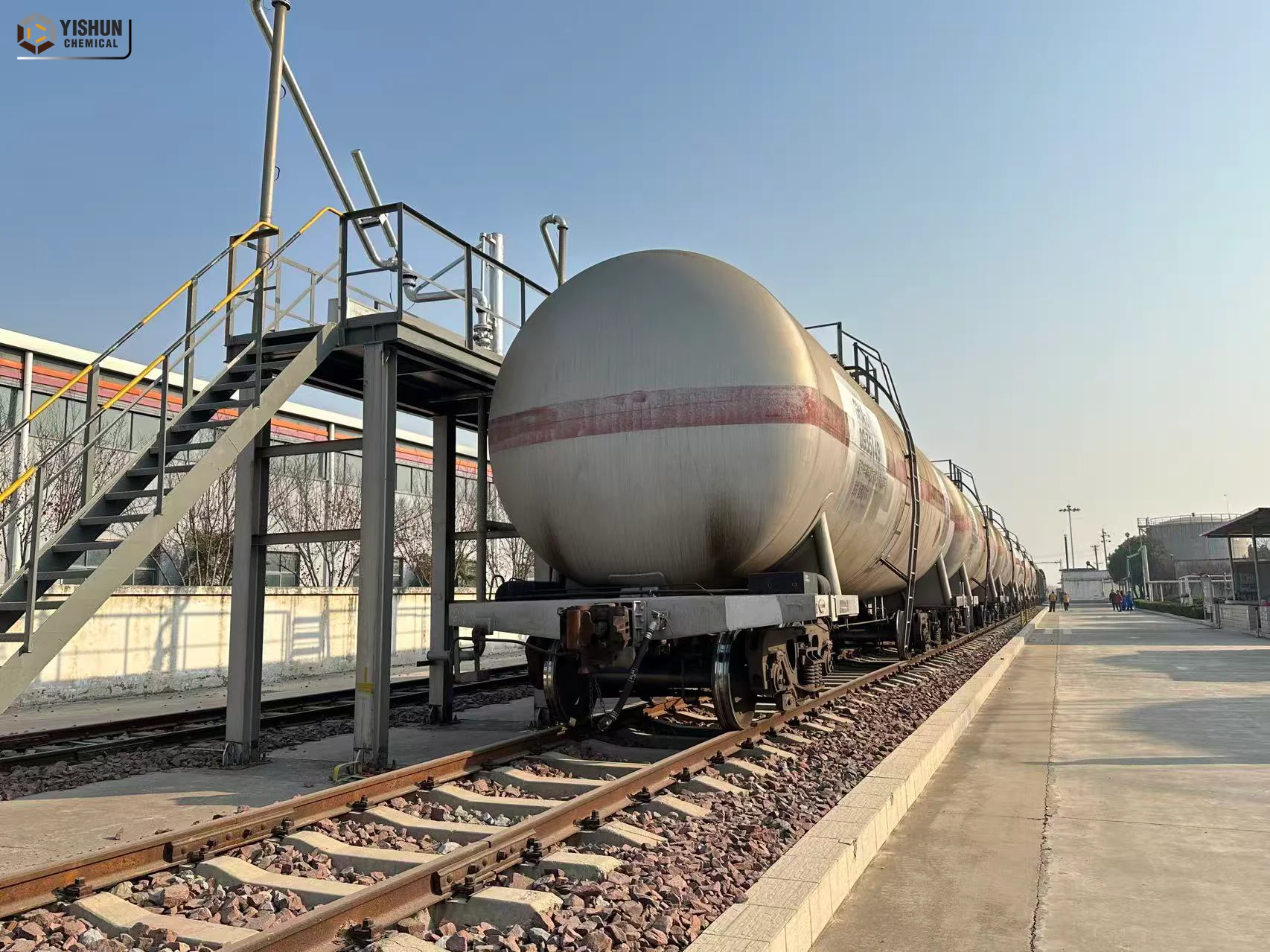
Yishun Chemical’s styrene shipment arriving by rail in July 2026. Company-supplied photograph.
Russian Styrene Production Edged Lower in Early 2026
Industry data published by CIREC indicates that Russian styrene monomer production totaled 189,973 metric tons in the first quarter of 2026, compared with 198,389 tons in the same period of 2025. This represents a year-on-year decrease of approximately 4.2%.
The decline is meaningful, but it should not be described as proof that Russia can no longer meet domestic styrene demand. National supply also depends on inventories, downstream operating rates, contractual flows, regional availability and the ability to move material between producers and consumers.
For buyers, the practical message is not that all domestic supply has disappeared. It is that relying on nominal national capacity alone may no longer be sufficient for procurement planning.
Refinery Disruptions Add Risk—but Do Not Prove a Styrene Outage
Russia’s refining system experienced extensive disruption during the second quarter and July 2026. The Associated Press reported that Russian crude processing in June was approximately 25% lower than a year earlier and that about one-third of national refining capacity was offline.
These disruptions matter to the broader petrochemical chain because refineries and integrated petrochemical complexes influence feedstock availability, energy supply and domestic logistics. Styrene is normally produced through the ethylbenzene chain, which depends on benzene and ethylene.
However, a refinery shutdown does not automatically mean that a styrene unit has stopped. Public reports often identify damage to crude distillation or fuel-production equipment without confirming the operating status of associated aromatic or petrochemical units. Any direct link between a specific refinery incident and styrene availability therefore requires plant-level confirmation.
Buyers should treat refinery disruption as a supply-risk indicator, not as automatic evidence of a confirmed styrene shortage.
New Russian Capacity Is a Medium-Term Development
Russia is investing in additional domestic styrene capacity. SIBUR reported in June 2026 that its new Nizhnekamsk styrene-chain project had reached 54% completion.
The complex is designed to add 400,000 tons per year of styrene and 250,000 tons per year of polystyrene capacity. Its scheduled start-up is in 2028.
This project could materially change Russia’s styrene and downstream polymer balance after commissioning. It does not, however, provide additional commercial supply during 2026. Buyers managing near-term production requirements must still evaluate currently operating capacity, spot availability and import alternatives.
Yishun Chemical Has Received 2,000 Metric Tons of Spot Styrene
To support customers facing greater supply uncertainty, Yishun Chemical recently purchased 2,000 metric tons of spot styrene from Sinopec. The material has arrived by rail and has been received into storage.
This physical inventory gives qualified bulk buyers a concrete supply option rather than a forward sourcing promise. The stock is available for order allocation and can support prompt shipment scheduling, subject to specification confirmation, contract terms, destination review, documentation and transport arrangements.
Russian traders, distributors and industrial users may submit their required quantity, destination, packing preference and COA, SDS or TDS requirements for confirmation. Yishun Chemical’s normal minimum order quantity is one 20-foot full container load.
The inventory statement and rail-arrival photograph are based on Yishun Chemical’s internal procurement and warehouse receipt records supplied for publication.
What Russian Styrene Buyers Should Verify
When evaluating an alternative styrene supply, procurement teams should confirm more than the headline price.
- Product identity and specification: State Styrene Monomer, CAS 100-42-5, the required purity and any process-specific quality limits.
- Required quantity: Provide the order quantity and expected purchasing frequency.
- Final destination: Identify the destination country, city or terminal so the supplier can assess available transport options and quotation terms.
- Packing and handling requirements: Confirm the acceptable packing format and any receiving-site restrictions before the supplier prepares an offer.
- Technical documents: Request the applicable COA, SDS and TDS for technical and purchasing review. The specification in the commercial offer should remain consistent with the approved documentation.
- Quotation basis: Check the currency, quantity, packing, delivery basis, offer validity and any items excluded from the quotation.
- Delivery contingency: If production continuity depends on styrene availability, discuss acceptable loading windows and alternative procurement timing before inventory reaches a critical level.
Avoid Treating Every Market Signal as a Confirmed Shortage
A rise in buyer inquiries may reflect several conditions: a temporary regional imbalance, delayed domestic deliveries, uncertainty about future production, logistics constraints or an effort to qualify backup suppliers.
For that reason, buyers should avoid basing decisions on a single outage headline. The stronger approach is to compare verified production information, actual supplier availability, documentation and destination-specific delivery conditions.
Companies using styrene in polystyrene, ABS, synthetic rubber, resins and other polymer applications can review Yishun Chemical’s Styrene product information and broader monomer product range.