


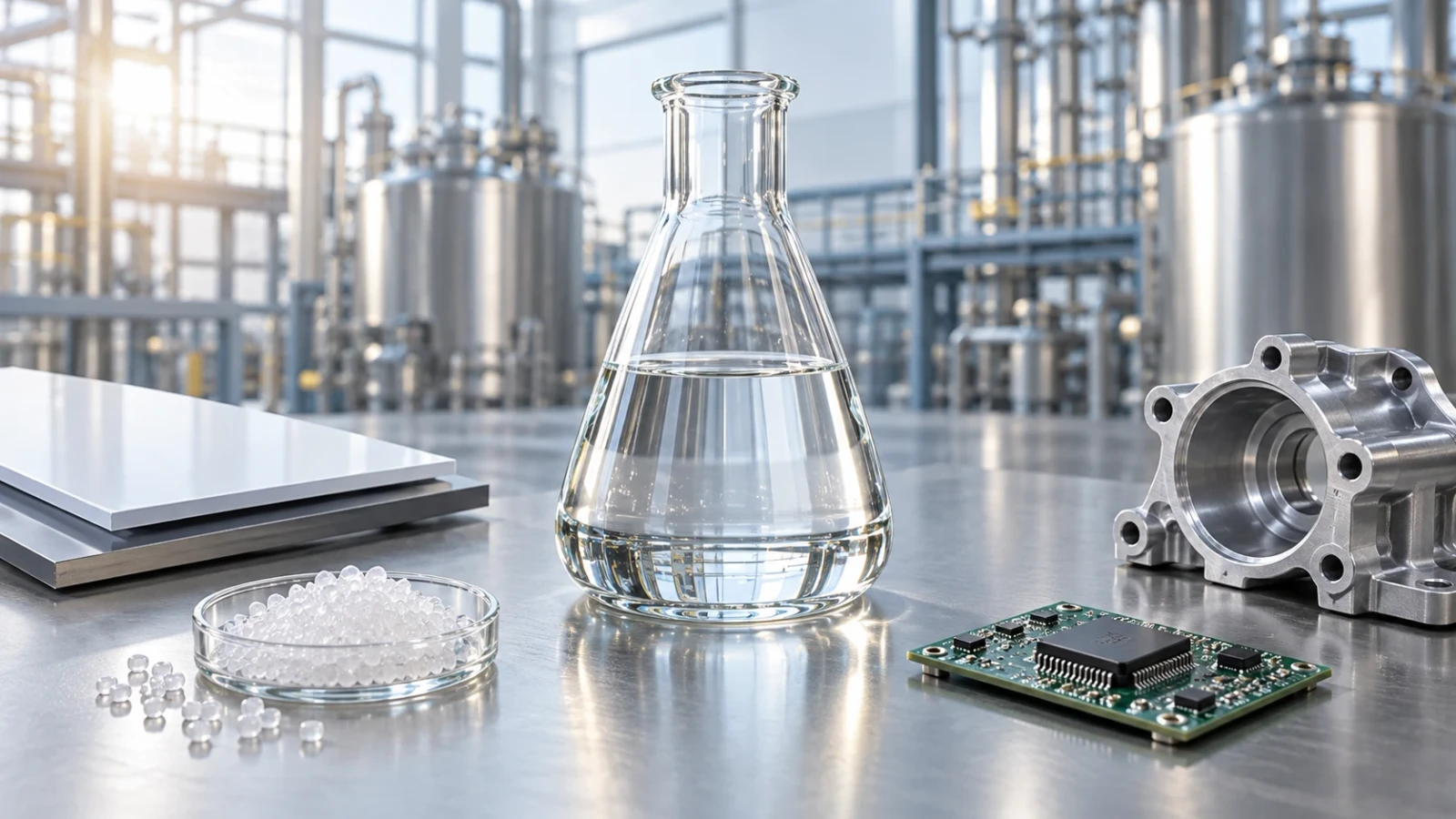
Acetone, also known as 2-propanone or dimethyl ketone, is a fast-evaporating ketone solvent and chemical intermediate. It is widely used in industrial cleaning, coatings, adhesives, electronics cleaning, pharmaceutical processing and chemical synthesis.
For industrial buyers, the key questions are not only what acetone is, but also whether the offered purity, water content, documentation, packaging and delivery plan match the intended application.
What Is Acetone?
Acetone is a volatile organic compound with the chemical formula C₃H₆O and CAS number 67-64-1. Under normal conditions, it is a clear, colorless liquid with a distinctive odor. Acetone evaporates quickly and is completely miscible with water.
It is used in two main ways:
- As a solvent in industrial formulations and cleaning processes.
- As a chemical intermediate for producing plastics, resins and other chemicals.
The required specification may vary significantly between a cleaning application, a coating formulation and a chemical synthesis process.
Key Acetone Properties
| Property | Typical reference value |
|---|---|
| Chemical formula | C₃H₆O |
| CAS number | 67-64-1 |
| Molecular weight | 58.08 g/mol |
| Boiling point | Approximately 56.5°C |
| Flash point | Approximately -17.8°C |
| Density | Approximately 0.7845 g/cm³ at 20°C |
| Water solubility | Miscible |
| UN number | UN 1090 |
| Common industrial grade | 99.5% purity |
These values are general reference data. They do not replace the supplier’s current Certificate of Analysis, Safety Data Sheet or Technical Data Sheet.
Yishun Chemical currently lists industrial Acetone with a stated purity of 99.5%. Buyers should confirm the current batch specification before placing an order.
How Is Acetone Produced?
The conventional industrial route is the cumene process. In this process, benzene and propylene are used to produce cumene. Cumene is then oxidized and cleaved to produce phenol and acetone as co-products.
Acetone can also be produced from isopropyl alcohol, particularly for certain high-purity applications.
The production route alone does not determine whether a shipment is suitable for a specific process. Buyers should focus on the agreed specification, impurity limits and batch analysis shown in the COA.
How Is Acetone Used?
Acetone as an Industrial Solvent
Acetone combines strong solvency with rapid evaporation and complete water miscibility. These properties make it useful in many industrial applications, including:
- Industrial cleaning and degreasing
- Paints and coatings
- Adhesives and sealants
- Printing inks
- Resin processing
- Electronics cleaning
- Pharmaceutical processing
- Chemical formulation and laboratory-scale industrial processes
In cleaning applications, acetone can help remove oils, residues, coatings and some resin materials. In coatings and adhesives, it may be used to dissolve or adjust the viscosity of formulation components.
Its rapid evaporation can support faster drying, but it can also reduce open time in some formulations. For this reason, the correct solvent balance should be tested against the customer’s process requirements.
Acetone as a Chemical Intermediate
Acetone is also used as a feedstock in the production of other chemicals and materials. It is associated with the production of:
- Acrylic plastics
- Bisphenol A
- Polycarbonate
- Epoxy resins
- Other chemical intermediates
These materials are used in construction, automotive parts, electrical and electronic products, coatings, adhesives and consumer goods.
The suitable acetone grade depends on the downstream process. A manufacturer of coatings may focus on water, color and residue, while a chemical producer may require different impurity limits and process controls.
Acetone Storage and Handling
Acetone is highly flammable and evaporates readily. Storage and handling should therefore be managed in accordance with the current SDS, local regulations and the customer’s site procedures.
Important considerations include:
- Keep the product away from heat, sparks and open flames.
- Use suitable ventilation to control vapor accumulation.
- Control static electricity during loading and unloading.
- Confirm that storage tanks, hoses and packaging are compatible with the product.
- Follow applicable dangerous-goods transportation requirements.
Acetone is identified as UN 1090 for transport. The final transport classification, packaging and documentation should be confirmed for the specific shipment and destination.
What Should Buyers Check Before Ordering Acetone?
A useful Acetone inquiry should include:
- Product name and CAS number: Acetone, CAS 67-64-1.
- Required purity and grade.
- Application and critical quality requirements.
- Water, color, residue or other impurity limits where applicable.
- Order quantity and expected consumption schedule.
- Destination port and preferred Incoterm.
- Preferred packaging or bulk transport method.
- Required documents, such as COA, SDS, TDS, packing list, invoice and origin documents.
- Requested loading or arrival window.
- Any end-user or export compliance information required for the transaction.
For certain destinations or transaction roles, additional export documents may be requested. Buyers should confirm the document checklist before finalizing the shipment schedule.
Frequently Asked Questions
Is Acetone miscible with water?
Yes. Acetone is completely miscible with water. However, compatibility with a specific formulation, resin or coating system should still be confirmed through technical testing.
What information is required for an Acetone quotation?
Buyers should provide the required purity, application, quantity, destination, packaging preference, delivery window and document requirements. This allows the supplier to evaluate a realistic supply and logistics plan.
Yishun Chemical supplies industrial Acetone for bulk international orders. Buyers can review our Acetone product information and submit a bulk Acetone RFQ.