

Styrene, commonly called styrene monomer, is a liquid raw material used to manufacture plastics, synthetic rubber, resins and composite materials. For industrial buyers, the key questions are not only what styrene is, but also whether the offered grade, inhibitor level, documentation and delivery plan are suitable for the intended process.
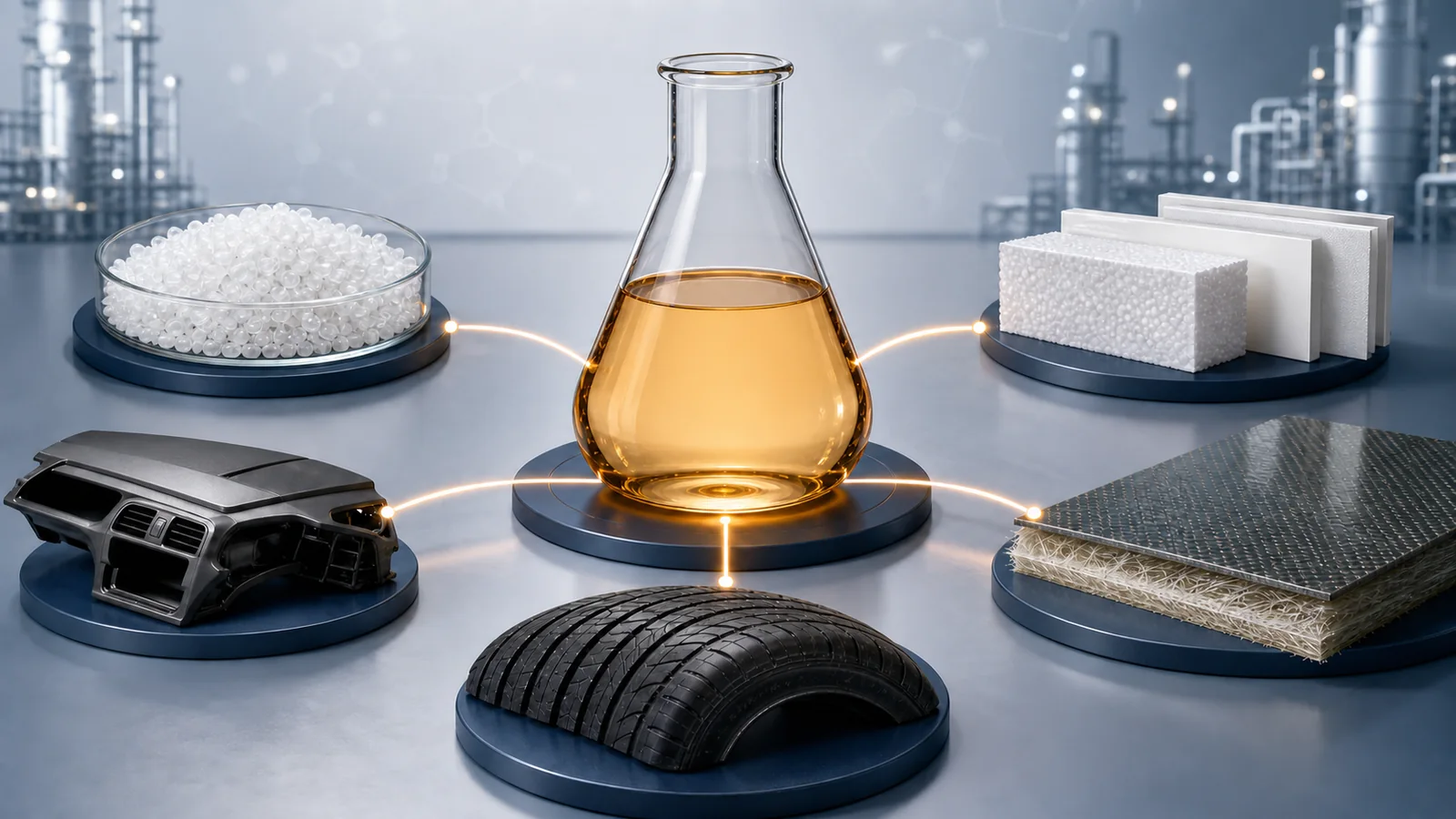
Illustrative image: styrene monomer as a feedstock for major polymer applications.
What Is Styrene Monomer?
Styrene monomer is a volatile aromatic hydrocarbon with the chemical formula C₈H₈ and CAS number 100-42-5. Under normal conditions, pure styrene is generally a clear, colorless liquid, although commercial material may appear slightly yellow.
The terms “styrene” and “styrene monomer” normally refer to the same chemical. “Monomer” describes its function as a small reactive molecule that can join with other molecules during polymerization. Styrene is not the same as polystyrene: styrene is the liquid starting material, while polystyrene is the solid polymer produced from it.
Key Styrene Properties
| Property | Typical reference value |
|---|---|
| Chemical formula | C₈H₈ |
| CAS number | 100-42-5 |
| UN number | UN 2055 |
| Molecular weight | 104.15 g/mol |
| Boiling point | Approximately 145°C |
| Flash point | Approximately 31°C, closed cup |
| Density | Approximately 0.906 g/cm³ at 20°C |
| Appearance | Clear, colorless to pale-yellow liquid |
These values identify the substance but do not replace a supplier’s Certificate of Analysis or Safety Data Sheet. Buyers should evaluate the actual batch specification against their own process requirements.
How Is Styrene Produced?
The conventional production route has two main stages. First, benzene reacts with ethylene to produce ethylbenzene. The ethylbenzene is then catalytically dehydrogenated to form styrene and hydrogen. This dehydrogenation step is an endothermic reaction that requires heat.
Another industrial route co-produces styrene monomer and propylene oxide, commonly called the SMPO process. Production route alone does not determine whether a shipment is suitable; the agreed specification and batch analysis remain more important to the buyer.
What Is Styrene Used For?
Styrene is an important building block for several polymer chains:
- Polystyrene (PS): packaging, appliance components, household products and medical applications.
- Expandable polystyrene (EPS): protective packaging and thermal insulation.
- ABS and SAN: automotive parts, electronics, appliances and consumer goods.
- Styrene-butadiene rubber and latex (SBR/SBL): tires, footwear, carpet backing, paper coatings and adhesives.
- Unsaturated polyester resin (UPR): fiberglass-reinforced products, construction panels, tanks, pipes, boats and other composites.
The required styrene specification can vary with the downstream process. A customer producing polystyrene may not evaluate every quality parameter in the same way as a resin or synthetic-rubber producer.
Why Does Styrene Contain an Inhibitor?
Styrene is a flammable, reactive liquid that can polymerize under unfavorable storage conditions, including excessive heat. Commercial styrene is therefore normally stabilized with a polymerization inhibitor. Inhibitor condition, temperature history, oxygen availability and storage duration can affect product stability.
Yishun Chemical’s standard styrene specification uses an inhibitor level of 15 ppm. Alternative levels can be customized according to the customer’s process requirements, subject to technical confirmation before the order is confirmed.
Buyers should not treat inhibitor content as an isolated number or change storage conditions without technical review. The supplier’s current SDS, handling guidance, local regulations and site procedures should always govern storage and unloading.
What Should Buyers Check Before Ordering?
A useful styrene inquiry should specify:
- Product identity: Styrene Monomer, CAS 100-42-5.
- Required purity and critical impurity limits.
- Required inhibitor level: Yishun Chemical’s standard level is 15 ppm; state any customized target in the RFQ.
- Order quantity and expected consumption schedule.
- Delivery destination and requested Incoterm.
- Preferred packing or bulk transport method.
- Required documents, such as COA, SDS, packing list, invoice and origin documents.
- Required loading or arrival window.
Buyers should also confirm whether a quotation refers to available material, an expected production allocation or a future procurement plan. Price comparison is meaningful only when specification, quantity, delivery basis, packing and payment terms are aligned.
Frequently Asked Questions
What inhibitor level does Yishun Chemical normally supply?
Yishun Chemical’s standard styrene specification uses an inhibitor level of 15 ppm. Alternative levels can be customized according to customer requirements, subject to technical confirmation.
What information is required for a styrene quotation?
Provide the required specification, quantity, destination, Incoterm, packing preference, delivery window and document requirements. This allows the supplier to evaluate a commercially realistic supply plan.
Yishun Chemical supplies industrial styrene monomer for bulk international orders. Buyers can review our Styrene product information and submit a bulk styrene RFQ with their required specification and delivery details.